




Sagar Black Sandstone
Contents |
[edit] Introduction
Sagar Black Sandstone is a commercially available natural sandstone used primarily for paving, landscaping and other architectural applications. The name describes a commercially traded sandstone product rather than a distinct geological classification, and the characteristics of products sold under the name may vary according to their geological source, processing and finish.
As with other natural stone, the suitability of Sagar Black Sandstone for a particular application depends on its physical and technical properties, dimensions, surface finish and the requirements of the proposed use. These characteristics should be established from representative samples and appropriate technical information rather than inferred from the commercial name or appearance.
[edit] Characteristics and appearance
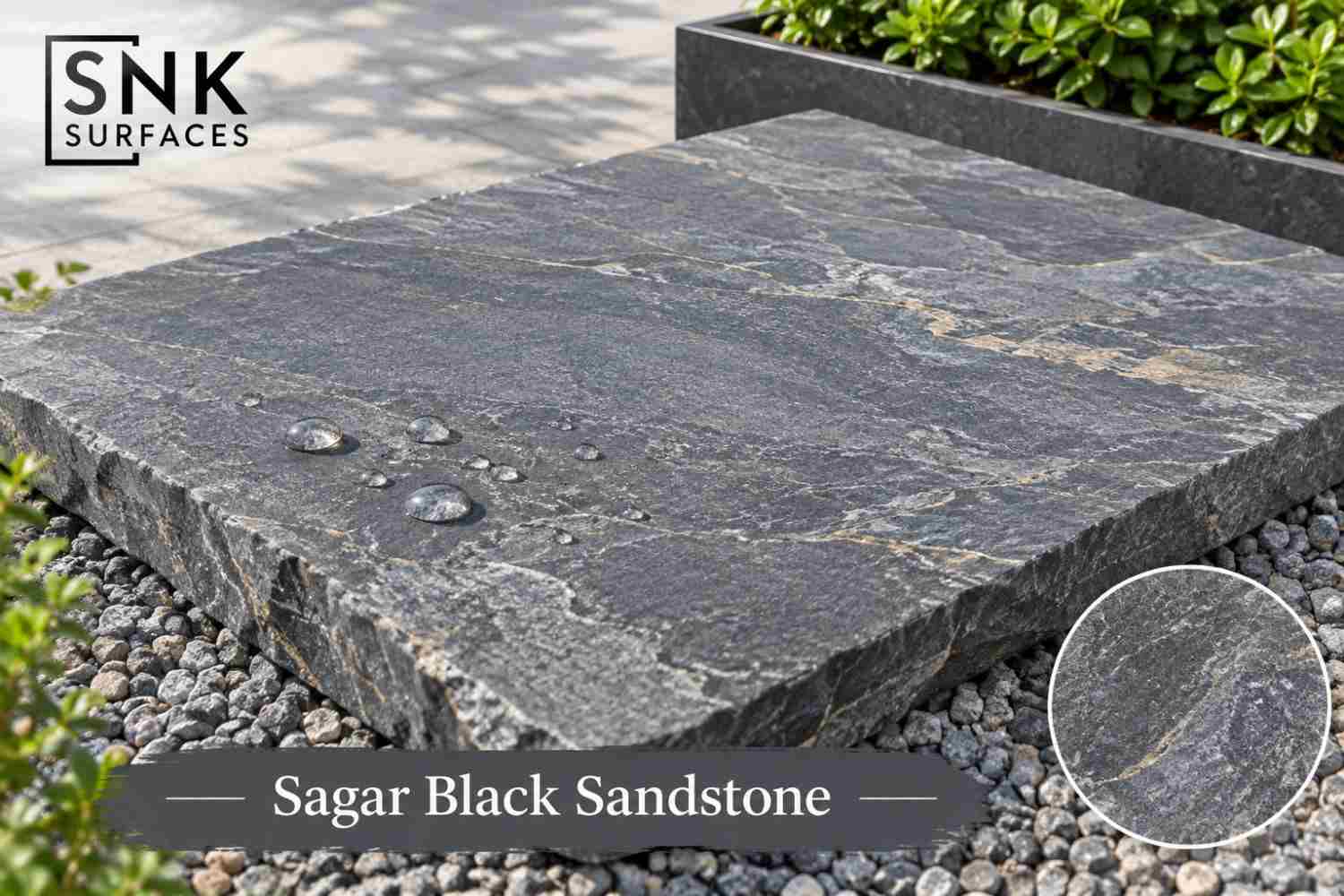
Sagar Black Sandstone generally has dark grey, charcoal and near-black tones. Individual pieces may contain variations in colour, texture and mineral content, and some material may include lighter or warmer markings. Natural variation means that individual paving units or slabs will not normally be identical.
The appearance can also change according to the surface finish. Naturally riven surfaces retain more of the texture produced by the stone's natural cleavage, while sawn and honed surfaces provide a flatter and more uniform appearance. Other finishes may be available depending on the characteristics of the particular stone and the intended application.
A representative range or control sample is preferable to a single sample when specifying the material for a project. This helps establish the likely range of colour and texture that will occur in the completed installation.
[edit] Origin and production
Sagar Black Sandstone is associated commercially with sandstone from India. The precise geological origin and characteristics of products sold under the name should be confirmed for the particular material being specified, as commercial stone names do not necessarily correspond to a single geological deposit.
Sandstone is a sedimentary rock formed from sand-sized mineral particles that have been deposited, compacted and cemented together. Quartz is commonly an important constituent, although the precise mineral composition and cementing materials vary between deposits.
Quarried stone is generally extracted in blocks or slabs and subsequently cut, calibrated and finished to produce paving units, slabs or other products. Processing and finishing may take place at locations separate from the quarry.
[edit] Sizes and thicknesses
Sagar Black Sandstone can be supplied in a range of dimensions and thicknesses, depending on the quarry, processing facilities and intended application. Commercial paving formats may include rectangular and square units, while larger slabs may be produced for architectural applications.
The dimensions and thickness required should be determined by the proposed use and the characteristics of the particular stone. There is no single thickness that is suitable for all paving, cladding or other applications.
Calibrated stone is processed to achieve more consistent thickness, which can simplify installation. The dimensional tolerances of the specified product should nevertheless be established before ordering.
[edit] Finishes
A range of surface finishes may be available for Sagar Black Sandstone. Common finishes for sandstone products include:
- riven, retaining the naturally split texture of the stone;
- sawn, producing a relatively flat and uniform surface;
- honed, producing a smoother surface with a relatively low sheen;
- sandblasted or shot-blasted, producing a textured surface; and
- tumbled, producing softened edges and a weathered appearance.
The finish affects both appearance and performance. Surface texture can influence slip resistance, cleaning requirements and the suitability of the stone for particular applications. Where slip resistance is important, the performance of the actual stone and finish should be established through appropriate testing rather than assumed from the name of the finish.
[edit] Applications
Sagar Black Sandstone may be used for a range of construction and landscaping applications where its physical properties are appropriate. These can include:
- patios, terraces and other external paving;
- paths and courtyards;
- steps and other landscape features;
- walling and copings;
- building facades and natural stone cladding; and
- internal flooring and other architectural applications.
The suitability of the stone depends on the application. Stone suitable for pedestrian paving should not automatically be assumed to be suitable for vehicle traffic. Driveways and other areas subject to vehicle loading require consideration of the stone's mechanical properties, thickness, dimensions, bedding and supporting construction.
Natural stone cladding also requires consideration of the weight and dimensions of the stone, the substrate and the fixing system. Thin stone used as cladding is generally supported and fixed to the structural substrate by an appropriate mechanical or proprietary system rather than being treated as structural masonry.
[edit] Selection and specification
Selection should begin with the intended application and the environmental and loading conditions to which the stone will be exposed. Relevant properties can include:
- water absorption;
- density;
- flexural strength;
- compressive strength;
- resistance to abrasion;
- resistance to freeze-thaw cycles; and
- slip or skid resistance.
The properties required will depend on the application and exposure conditions. In exposed or frost-prone environments, the frost resistance of the particular product should be established rather than assumed from its commercial name.
Colour and texture should also be considered. Natural stone can vary between deposits, blocks and production batches, so representative samples or a control range should be assessed for projects where appearance is important. Replacement material obtained at a later date may not exactly match the original stone.
[edit] Installation and maintenance
External sandstone paving should be installed on an appropriately designed and prepared sub-base and bedding system. The supporting construction should provide adequate support, falls and drainage for the expected loading and site conditions.
The laying method, bedding and jointing system should be appropriate to the paving units and the supporting construction. Paving should generally be laid to appropriate falls to reduce prolonged standing water.
Sandstone is a porous natural material and can absorb water and contaminants. Regular sweeping and appropriate cleaning can help maintain its appearance and reduce the accumulation of organic matter such as moss and algae.
Cleaning products should be suitable for the particular sandstone and finish. Strongly acidic or otherwise aggressive cleaning agents can damage some stone surfaces and should not be used unless their suitability has been established. Excessive pressure washing can also damage some finishes.
Sealing may be appropriate for some applications but is not universally required. Where a sealer is used, it should be selected for the particular stone, finish and intended use. Sealing does not compensate for inadequate drainage, unsuitable installation or inappropriate stone selection.
[edit] Purchasing and quality control
When purchasing Sagar Black Sandstone, the quarry or geological provenance of the material should be established where this is relevant to the specification. The supplier should also be able to provide appropriate information about the stone's dimensions, finish and technical characteristics.
For larger projects, samples should be assessed before placing a bulk order. A representative range of material is preferable to relying on a single sample because natural variation can occur within a shipment.
For imported stone, the purchaser should establish who is responsible for quarrying, processing, packaging, transport and importation. Packaging should protect the stone against damage during handling and transportation, and any applicable requirements for timber packaging should be met.
Technical documentation and test results should be checked against the requirements of the project. Certification should not be treated as a general guarantee of quality: the relevant certification and test information should be examined to establish what it covers and whether it applies to the particular product and intended use.
[edit] Related articles on Designing Buildings
Featured articles
Check out some of the best features and news from Designing Buildings as well as key stories from around the web.

Government approach could undermine delivery and regeneration.
World's first mass timber data centre.

The overlooked environmental aspect of data centre development.
Introduction to radon awareness

New technical information sheet published by CIOB.

Updated supplier guide can help electrical contractors engage with NHP.

CIAT confirm the winners of the 2026 architectural technology awards.

Government launches a one stop shop for flood preparedness.

Sir Edwin Lutyens: Britain's greatest architect? Book review.

CIOB publishes free template to help assess and manage risks.
ECA's reflections on Party Conference season

Burnham wants to be confident of winning before asking for a fresh mandate.
New Chief Construction and Scientific Adviser

Sergio Cavalaro, Professor of Infrastructure Systems at Loughborough University.
Building safety levy for England

CIAT publish estimator tool for members.

Water sector faces a growing crisis that could slow the delivery of vital infrastructure.